
-
By: Agnivesh
-
July 28, 2026
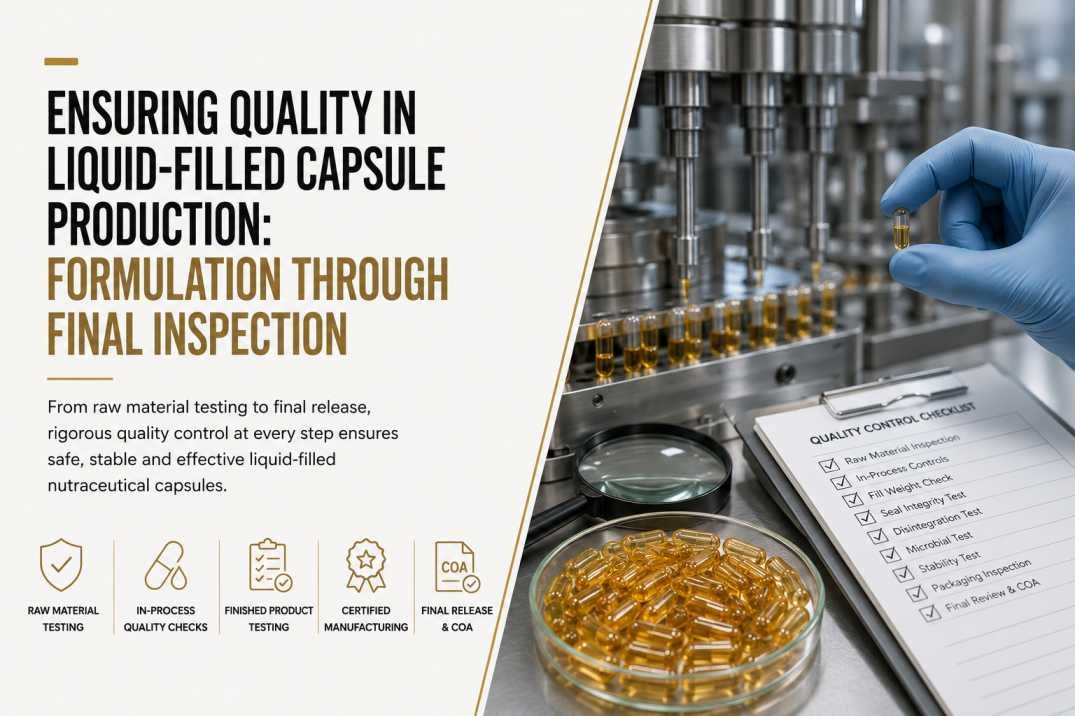
Ensuring Quality in Liquid-Filled Capsule Production: Formulation Through Final Inspection
Which Quality Checks Are Performed Prior to Manufacturing?
- Verifying the identity and authenticity of all ingredients
- Evaluating the potency and purity of active compounds
- Checking moisture content levels
- Screening for heavy metals
- Testing for pesticide residues when relevant
- Analyzing residual solvents
- Detecting microbial contamination
What documentation (COA, MSDS) should suppliers provide?
Testing quality isn’t just confined to the laboratory. The manufacturer checks the supporting documentation submitted by the suppliers prior to acceptance of raw materials. This often includes:
– Certificate of Analysis (COA) – Declaring that the raw material meets predetermined specification.
– Material Safety Data Sheet (MSDS) – Safety and handling instructions.
– Regulatory compliance documentation
– Allergen declarations
– Non-GMO statements (if relevant)
– Halal or Kosher certifications (if needed)
– country of origin statement
Suppliers approved by the manufacturer undergo periodic assessments to ensure that quality levels remain consistent for each batch.
What In-Process Quality Checks Happen During Capsule Filling?
Once manufacturing is underway, consistent monitoring controls against defects.
How is fill weight consistency managed?
Precision fill weights are paramount, as each capsule should contain the exact specified dose. To control fill weights, manufacturers conduct:
- Automatic fill weight monitoring
- Production sampling at intervals
- Statistical process control (SPC)
- Equipment calibration verification
- Validation of the liquid ingredient density
The system alerts operators when fill weights go beyond designated limits, necessitating corrective measures to keep batch consistency at the correct level. Precise doses of premium ingredients like omega oils, curcumin extracts, CoQ10, vitamin D3, and botanical concentrates are vital.
How is capsule seal/band integrity tested (leak test)?
Hard liquid-fill capsules should be fully sealed to avoid spills during storage and shipment. Seal integrity is verified by:
Vacuum leak test
Pressure testing
Visual inspection
Mechanical stress testing
Drop testing (where appropriate)
Quality teams examine the seals. These tests protect oil contents from oxidation, contamination and loss, and also enhance overall shelf stability.
What environmental controls (humidity, temperature) are critical in a filling facility?
The manufacturing environment directly impacts the quality of the filled capsule shell. A good fill facility actively manages these controls:
Temperature
Relative humidity
Air filtration
Differential air pressure
Cleanroom environment
Particle counts
Controlled conditions prevent capsule degradation, reduce potential for micro contamination, and enhance seal efficacy. Environmental conditions also maintain compliance with GMP guidelines.
What Finished Product Tests Are Conducted?
There are various tests for finished capsules after the batch is finished, and it must fulfill some specifications before release.
Are disintegration/dissolution testing required?
Yes, even though it’s liquid-filled hard capsules and uses oil-based fill, it still has to be functional post-ingestion.
Manufacturers perform:
Disintegration testing
Dissolution testing
Release profile testing
This indicates that capsule shell ruptures as intended and the active ingredient is released appropriately.
How is microbial testing performed for nutraceutical capsules?
The product safety for consumers must be taken into consideration regarding microbes.
Tests are performed on the final product:
Total aerobic microbial count
Yeast and mold count
The absence of specific pathogens like Salmonella, E. Coli, Staphylococcus aureus, etc.
Contamination indicators
If the product doesn’t fulfill the microbial standards, the batch would be rejected and thoroughly investigated before it is released.
What accelerated stability testing is standard?
What Certifications Should a Liquid Filled Capsule Manufacturer in India Hold?
FAQs
Q. What quality tests are done on liquid filled capsules before shipping?
Manufacturers perform fill weight verification, seal integrity testing, visual inspection, microbial testing, disintegration testing, stability assessment, packaging inspection, and final documentation review before issuing the Certificate of Analysis (COA).Q. How is leak-proofing tested in liquid filled capsules?
Leak-proofing is evaluated using vacuum leak tests, pressure testing, visual inspections, and seal integrity assessments to ensure capsules remain intact throughout storage and transportation.Q. What certifications indicate a GMP-compliant capsule manufacturer in India?
Key certifications include GMP, HACCP, ISO 22000, FSSAI licensing, and product-specific certifications such as Halal or Kosher, depending on market requirements.Q. Is microbial testing mandatory for nutraceutical capsules?
Yes. Microbial testing is an essential quality control requirement to verify that finished products comply with established microbiological safety limits and are free from harmful pathogens. What is a Certificate of Analysis (COA) and why does it matter? A COA is a quality document that summarizes laboratory test results for a manufacturing batch. It confirms that the finished product meets predefined specifications for identity, potency, purity, microbiological safety, and other quality parameters before release.Category
- Blog (26)
- Uncategorized (1)