
-
By: Agnivesh
-
July 28, 2026
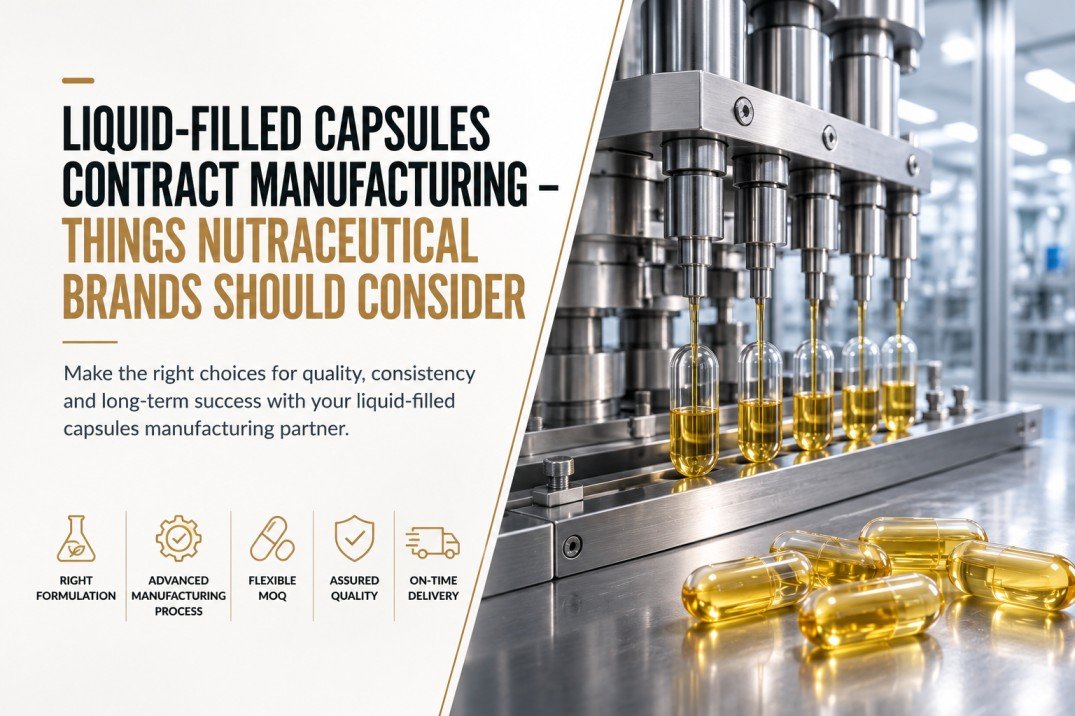
Liquid-Filled Capsule Contract Manufacturing: What Nutraceutical Brands Should Consider
Liquid-filled hard capsules offer nutraceutical brands a practical way to deliver oils, lipid-soluble ingredients and selected semi-solid formulations in a precise, convenient dosage form. By working with an experienced contract manufacturing partner, a brand can move from concept to commercial production without investing in a dedicated filling, sealing and quality-control facility.
What Is Liquid-Filled Capsule Contract Manufacturing?
Under a contract manufacturing arrangement, a specialist manufacturer develops and produces liquid-filled hard capsules on behalf of a nutraceutical or wellness brand. Depending on the project, the scope may include formulation development, ingredient sourcing, pilot trials, commercial manufacturing, capsule banding, quality testing, packaging and documentation.
This model is particularly useful for new brands, growing supplement businesses and established companies that want to add an innovative dosage form without purchasing specialized equipment or building a new production line.
How Is Liquid Filling Different from Powder or Pellet Filling?
Traditional hard capsules are commonly filled with powders, granules or pellets. Liquid-filled hard capsules contain an oil-based liquid, suspension or suitable semi-solid formulation. The fill must be compatible with the capsule shell and must maintain an appropriate viscosity for accurate dosing.
After filling, the capsule body and cap are sealed or banded to reduce leakage risk. This additional step is one of the main technical differences between conventional powder filling and liquid-filled hard capsule production.
Which Products Are Suitable for Liquid-Filled Hard Capsules?
Typical applications include nutritional oils, botanical oils, medium-chain triglyceride formulations, omega blends, fat-soluble vitamins, oleoresins and other lipophilic ingredients. Some formulations may also contain dispersed solids, provided the suspension remains stable and can be filled consistently.
Suitability should always be confirmed through formulation trials because shell compatibility, oxidation sensitivity, viscosity and storage conditions differ from product to product.
Why Do Brands Work with Manufacturers in India?
India has a well-established nutraceutical and pharmaceutical manufacturing ecosystem, access to technical talent and a broad supplier base. For international and domestic brands, an experienced Indian manufacturer can provide formulation support, scalable production and competitive commercial terms.
Cost should not be the only selection factor. The manufacturer’s technical capability, quality system, documentation, communication and ability to support the target market are equally important.
Key Factors to Review Before Signing a Contract
Formulation and R&D Support
A manufacturer’s formulation and R&D capabilities have a direct impact on product performance and manufacturability. Before commercial production begins, the formulation should be evaluated for ingredient compatibility, viscosity, oxidation stability and capsule shell compatibility. Pilot-scale trials also help validate filling performance and identify any issues related to precipitation, phase separation or long-term product stability.
Manufacturing Capability
Liquid-filled hard capsules require specialised filling and sealing technology to ensure accurate dosing and minimise the risk of leakage. Manufacturers with modern production equipment, capsule banding systems, flexible batch capacities and multiple capsule shell options are better equipped to handle different formulation requirements while maintaining consistent product quality.
Quality Systems
A robust quality management system ensures consistency throughout the manufacturing process. This includes qualification of raw materials, in-process quality monitoring, finished product testing, batch traceability and documented deviation management. Comprehensive quality controls help ensure that every production batch meets predefined specifications before release.
Certifications and Regulatory Compliance
Compliance with recognised manufacturing and food safety standards reflects a manufacturer’s commitment to quality and regulatory requirements. Certifications such as GMP, FSSAI, ISO 22000, HACCP, Halal and Kosher, where applicable, demonstrate that manufacturing processes are designed to meet the expectations of both domestic and international markets.
MOQ and Production Scalability
Minimum order quantity and production capacity should support both current business requirements and future growth. Manufacturers with flexible production planning can accommodate different batch sizes while maintaining consistent manufacturing processes as production volumes increase.
Lead Time and Documentation
Successful contract manufacturing depends on clear production planning and complete documentation. Timelines should account for formulation development, ingredient sourcing, manufacturing, quality testing, packaging and final dispatch. Each production batch should also be supported by appropriate documentation, including Certificates of Analysis (CoA), batch manufacturing records and other quality documents required for regulatory compliance and product traceability.
Common Mistakes to Avoid
Brands sometimes choose a supplier only on the basis of the lowest quotation. This can create problems if the manufacturer lacks formulation expertise, suitable sealing technology or adequate quality controls.
Other common mistakes include failing to verify certifications, accepting an unrealistic MOQ, overlooking stability requirements, not discussing packaging compatibility and failing to define ownership of formulas, artwork and regulatory documents.
Why Partner with AHCC Pvt Ltd?
AHCC Pvt Ltd supports nutraceutical and wellness brands with liquid-filled hard capsule development, contract manufacturing, capsule banding, quality testing and packaging support. Our team works with clients from initial concept and pilot development through scale-up and commercial production.
For a project assessment, share your proposed composition, target capsule size, market, pack format and expected order quantity with the AHCC Pvt Ltd team.
Frequently Asked Questions
Q. What is the minimum order quantity for liquid-filled capsules?
MOQ depends on the formula, capsule size, shell type, packaging and production requirements. It should be confirmed after the manufacturer reviews the project.
Q. How long does development and manufacturing take?
The timeline varies according to formulation readiness, ingredient availability, testing, packaging and batch size. A realistic schedule can be provided after technical review.
Q. Are vegetarian liquid-filled capsules available?
Vegetarian shell options may be possible, subject to formulation compatibility and availability.
Q. Are liquid-filled capsules always more expensive than tablets?
Not necessarily. Cost depends on ingredients, processing complexity, capsule shell, sealing, testing, packaging and volume.
Category
- Blog (26)
- Uncategorized (1)